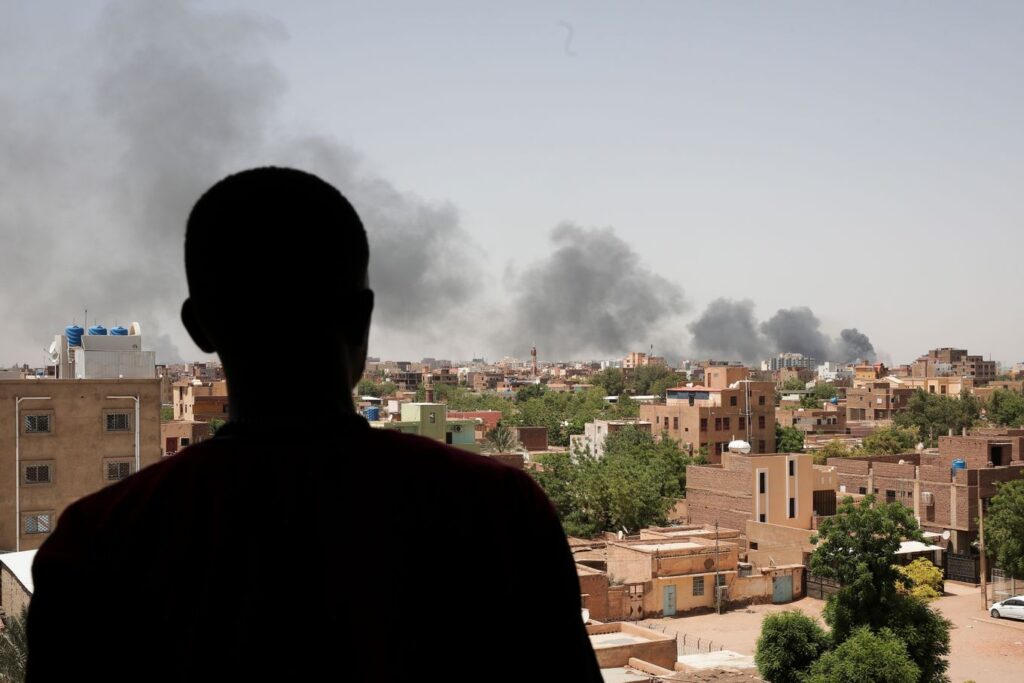
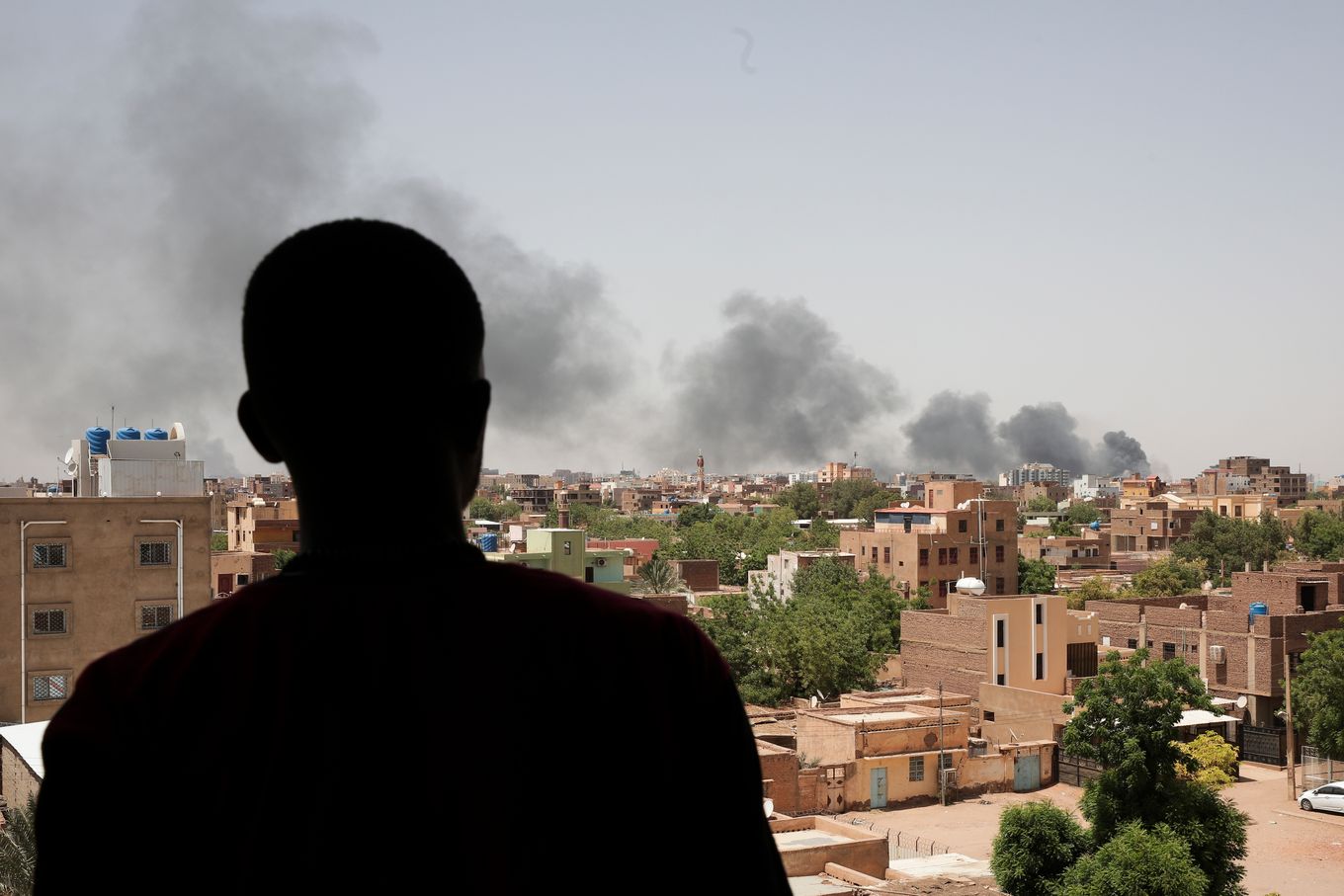
 Smoke is seen in Khartoum, the Sudanese capital, on Saturday. (Marwan Ali/AP)Chaos, lawlessness and fear grip much of Sudan. It’s been a week since tensions between the country’s two most prominent generals exploded into full-blown battles that have sprawled across the country of some 46 million people, turning the teeming capital, Khartoum, into a ghost town and triggering a wave of refugees fleeing for safety. Temporary cease-fires, including one over the Eid holiday, failed to stem the conflict, which at its root is a contest for power between Gen. Abdel Fattah al-Burhan, commander of the Sudanese armed forces and the de facto head of state, and Gen. Mohamed Hamdan Dagalo, universally referred to Hemedti, who heads the influential paramilitary Rapid Support Forces.In the shadow of their clashes, the Sudanese state is coming apart at its seams. Lacking power, water and vital supplies, or hit by heavy weapons, many hospitals have been forced to shut down. Armed groups of varying affiliation have looted houses and businesses, compelling civilians who have not found a way to escape to weigh the grim choice between hunger and deprivation indoors and the security risks outside. “Anything we hear in the news is a lie,” a Khartoum-based science teacher told my colleagues. “The fire is getting stronger. We can’t stay here. If you do not die from the bombs, you will die of hunger. There is nothing in the markets to eat.” Intense urban warfare in the capital led to mortar fire landing in civilian homes and a hodgepodge of local militias running rampant in various towns and neighborhoods. Conservative estimates from the World Health Organization suggest at least 400 people have been killed nationwide, with thousands more wounded. “Windows have been sealed against stray bullets and the stench of death,” my colleagues reported.Local staffers for a number of international organizations, including the World Food Program, are among the dead. Foreigners have been targets, too: A U.S. diplomatic convoy came under fire last week, a leading E.U. humanitarian official was shot and seriously injured. A host of foreign governments are trying to coordinate evacuations of their citizens from Sudan. The United States, which counts some 16,000 nationals in the country, evacuated its embassy personnel and their families in the early hours Sunday. So, too, did a host of other Western countries.Aid agencies warn of a deepening humanitarian crisis in a country that was already facing mounting hunger even before the fighting began. Thousands of people have trekked across the arid border with Chad; U.N. officials are preparing for some 100,000 Sudanese refugees to arrive in the coming days. At the end of last week, Abdou Dieng, the U.N.’s humanitarian coordinator for Sudan, urged peace: “As we are ending the holy month of Ramadan and celebrate Eid al-Fitr, a time of peace and reconciliation, I call on all parties to the conflict to immediately end the fighting and work towards a peaceful resolution,” he said. Peace seems nowhere in sight. In 2021, Burhan and Hemedti worked together to bring down a weak civilian-led government, placing themselves in power with assurances to the international community that they would shepherd through a democratic transition that had begun after the 2019 ouster of long-ruling dictator Omar al-Bashir. Instead, the two consolidated their positions, held civil society and the pro-democracy camp at arm’s length (even as they pledged in December to eventually restore civilian rule), and enriched themselves and their allies. Tensions came to a head amid disagreements over how and when to integrate Hemedti’s RSF into the regular Sudanese military. Now, the two leaders are vowing to fully defeat each other, with unprecedented scenes of violence gripping Khartoum. “Even if the army eventually does secure the capital, and Hemedti retreats to Darfur” — the insurgency-hit region where Hemedti built his reputation as the leader of a vicious pro-government militia — “a civil war could well follow, with potentially destabilising impact in neighbouring Chad, the Central African Republic, Libya and South Sudan, which are all already scarred by conflict to varying degrees,” explained a policy memo from the International Crisis Group last week. “Further, Sudan is riddled with countless other armed groups and communal militias, any or all of which could throw in its lot with Burhan or Hemedti, turning a two-sided war into a much more complex free-for-all, especially in the country’s peripheral areas.”Hemedti has reportedly received aid from renegade Libyan general Khalifa Hifter, whose own campaigns have been buttressed by Sudanese fighters from Darfur and who is closely linked to Russian mercenary company Wagner, which also has operations in Sudan. According to some reports, Wagner offered to transfer heavy weapons to Hemedti’s RSF. Russian officials have also eyed basing rights in Port Sudan, which could give the Kremlin a major naval presence in the Red Sea and, by extension, the Indian Ocean.Sudan finds itself at the center of a complicated regional chess game, with Russia just one of a web of outside powers vying for influence in Africa’s third-largest country. Egypt is a staunch ally of Burhan, who attended the same military college as Egypt’s own coup-plotting dictator, Abdel Fatah El-Sisi. The United Arab Emirates is publicly neutral, but enlisted Hemedti’s RSF in waging its campaigns in Yemen; in Dubai, Hemedti has secured a lucrative emporium for the Sudanese gold concessions that he controls.“Everyone wanted a chunk of Sudan and it couldn’t take all the meddling,” Magdi el-Gizouli, a Sudanese analyst at the Rift Valley Institute, a research group, told the New York Times. “Too many competing interests and too many claims, then the fragile balance imploded, as you can see now.” Diplomats who have navigated Sudan’s tortured politics fear an even darker turn in a nation that is no stranger to ruinous war. The experience of neighboring South Sudan, which won independence from Khartoum after decades of conflict only to be torn apart by the rivalries of two warlords, offers a troubling, if only partial, guide. “No situation in the past has been like this. It’s a nightmare,” Endre Stiansen, the Norwegian ambassador to Sudan, told Al Jazeera, warning that outside powers may make the situation worse. “The only way to get stability … is to have an inclusive transition towards democracy.”And yet there are reasons to be cynical about such rhetoric. “The precipitating event of the current war in Sudan was a reconciliation agreement and security sector reform plan that was pushed by the United States and the U.N. mission in Sudan,” wrote Justin Lynch in Foreign Policy. “Immediately after the coup [in 2021] … the United States and the U.N. revitalized the plan,” which, he added, simply “created a competition that incentivized [Hemedti] and Burhan to build up their forces.”Jeffrey Feltman, a former U.N. official and former U.S. envoy for the Horn of Africa, argued that the two generals can’t be part of a lasting solution. “The greatest disservice that could be done to the Sudanese people, to the integrity of Sudan as a sovereign state, to the security of Sudan’s neighbors, and indeed to international peace and security, would be to allow negotiations between the belligerents to yield yet another internationally endorsed compromise predicated on power-sharing,” Feltman wrote in a Washington Post op-ed. “At least now it should be clear that Burhan and Hemedti are not reformers — and that they will never be reformed.” 1,000 Words Smoke is seen in Khartoum, the Sudanese capital, on Saturday. (Marwan Ali/AP)Chaos, lawlessness and fear grip much of Sudan. It’s been a week since tensions between the country’s two most prominent generals exploded into full-blown battles that have sprawled across the country of some 46 million people, turning the teeming capital, Khartoum, into a ghost town and triggering a wave of refugees fleeing for safety. Temporary cease-fires, including one over the Eid holiday, failed to stem the conflict, which at its root is a contest for power between Gen. Abdel Fattah al-Burhan, commander of the Sudanese armed forces and the de facto head of state, and Gen. Mohamed Hamdan Dagalo, universally referred to Hemedti, who heads the influential paramilitary Rapid Support Forces.In the shadow of their clashes, the Sudanese state is coming apart at its seams. Lacking power, water and vital supplies, or hit by heavy weapons, many hospitals have been forced to shut down. Armed groups of varying affiliation have looted houses and businesses, compelling civilians who have not found a way to escape to weigh the grim choice between hunger and deprivation indoors and the security risks outside. “Anything we hear in the news is a lie,” a Khartoum-based science teacher told my colleagues. “The fire is getting stronger. We can’t stay here. If you do not die from the bombs, you will die of hunger. There is nothing in the markets to eat.” Intense urban warfare in the capital led to mortar fire landing in civilian homes and a hodgepodge of local militias running rampant in various towns and neighborhoods. Conservative estimates from the World Health Organization suggest at least 400 people have been killed nationwide, with thousands more wounded. “Windows have been sealed against stray bullets and the stench of death,” my colleagues reported.Local staffers for a number of international organizations, including the World Food Program, are among the dead. Foreigners have been targets, too: A U.S. diplomatic convoy came under fire last week, a leading E.U. humanitarian official was shot and seriously injured. A host of foreign governments are trying to coordinate evacuations of their citizens from Sudan. The United States, which counts some 16,000 nationals in the country, evacuated its embassy personnel and their families in the early hours Sunday. So, too, did a host of other Western countries.Aid agencies warn of a deepening humanitarian crisis in a country that was already facing mounting hunger even before the fighting began. Thousands of people have trekked across the arid border with Chad; U.N. officials are preparing for some 100,000 Sudanese refugees to arrive in the coming days. At the end of last week, Abdou Dieng, the U.N.’s humanitarian coordinator for Sudan, urged peace: “As we are ending the holy month of Ramadan and celebrate Eid al-Fitr, a time of peace and reconciliation, I call on all parties to the conflict to immediately end the fighting and work towards a peaceful resolution,” he said. Peace seems nowhere in sight. In 2021, Burhan and Hemedti worked together to bring down a weak civilian-led government, placing themselves in power with assurances to the international community that they would shepherd through a democratic transition that had begun after the 2019 ouster of long-ruling dictator Omar al-Bashir. Instead, the two consolidated their positions, held civil society and the pro-democracy camp at arm’s length (even as they pledged in December to eventually restore civilian rule), and enriched themselves and their allies. Tensions came to a head amid disagreements over how and when to integrate Hemedti’s RSF into the regular Sudanese military. Now, the two leaders are vowing to fully defeat each other, with unprecedented scenes of violence gripping Khartoum. “Even if the army eventually does secure the capital, and Hemedti retreats to Darfur” — the insurgency-hit region where Hemedti built his reputation as the leader of a vicious pro-government militia — “a civil war could well follow, with potentially destabilising impact in neighbouring Chad, the Central African Republic, Libya and South Sudan, which are all already scarred by conflict to varying degrees,” explained a policy memo from the International Crisis Group last week. “Further, Sudan is riddled with countless other armed groups and communal militias, any or all of which could throw in its lot with Burhan or Hemedti, turning a two-sided war into a much more complex free-for-all, especially in the country’s peripheral areas.”Hemedti has reportedly received aid from renegade Libyan general Khalifa Hifter, whose own campaigns have been buttressed by Sudanese fighters from Darfur and who is closely linked to Russian mercenary company Wagner, which also has operations in Sudan. According to some reports, Wagner offered to transfer heavy weapons to Hemedti’s RSF. Russian officials have also eyed basing rights in Port Sudan, which could give the Kremlin a major naval presence in the Red Sea and, by extension, the Indian Ocean.Sudan finds itself at the center of a complicated regional chess game, with Russia just one of a web of outside powers vying for influence in Africa’s third-largest country. Egypt is a staunch ally of Burhan, who attended the same military college as Egypt’s own coup-plotting dictator, Abdel Fatah El-Sisi. The United Arab Emirates is publicly neutral, but enlisted Hemedti’s RSF in waging its campaigns in Yemen; in Dubai, Hemedti has secured a lucrative emporium for the Sudanese gold concessions that he controls.“Everyone wanted a chunk of Sudan and it couldn’t take all the meddling,” Magdi el-Gizouli, a Sudanese analyst at the Rift Valley Institute, a research group, told the New York Times. “Too many competing interests and too many claims, then the fragile balance imploded, as you can see now.” Diplomats who have navigated Sudan’s tortured politics fear an even darker turn in a nation that is no stranger to ruinous war. The experience of neighboring South Sudan, which won independence from Khartoum after decades of conflict only to be torn apart by the rivalries of two warlords, offers a troubling, if only partial, guide. “No situation in the past has been like this. It’s a nightmare,” Endre Stiansen, the Norwegian ambassador to Sudan, told Al Jazeera, warning that outside powers may make the situation worse. “The only way to get stability … is to have an inclusive transition towards democracy.”And yet there are reasons to be cynical about such rhetoric. “The precipitating event of the current war in Sudan was a reconciliation agreement and security sector reform plan that was pushed by the United States and the U.N. mission in Sudan,” wrote Justin Lynch in Foreign Policy. “Immediately after the coup [in 2021] … the United States and the U.N. revitalized the plan,” which, he added, simply “created a competition that incentivized [Hemedti] and Burhan to build up their forces.”Jeffrey Feltman, a former U.N. official and former U.S. envoy for the Horn of Africa, argued that the two generals can’t be part of a lasting solution. “The greatest disservice that could be done to the Sudanese people, to the integrity of Sudan as a sovereign state, to the security of Sudan’s neighbors, and indeed to international peace and security, would be to allow negotiations between the belligerents to yield yet another internationally endorsed compromise predicated on power-sharing,” Feltman wrote in a Washington Post op-ed. “At least now it should be clear that Burhan and Hemedti are not reformers — and that they will never be reformed.” 1,000 Words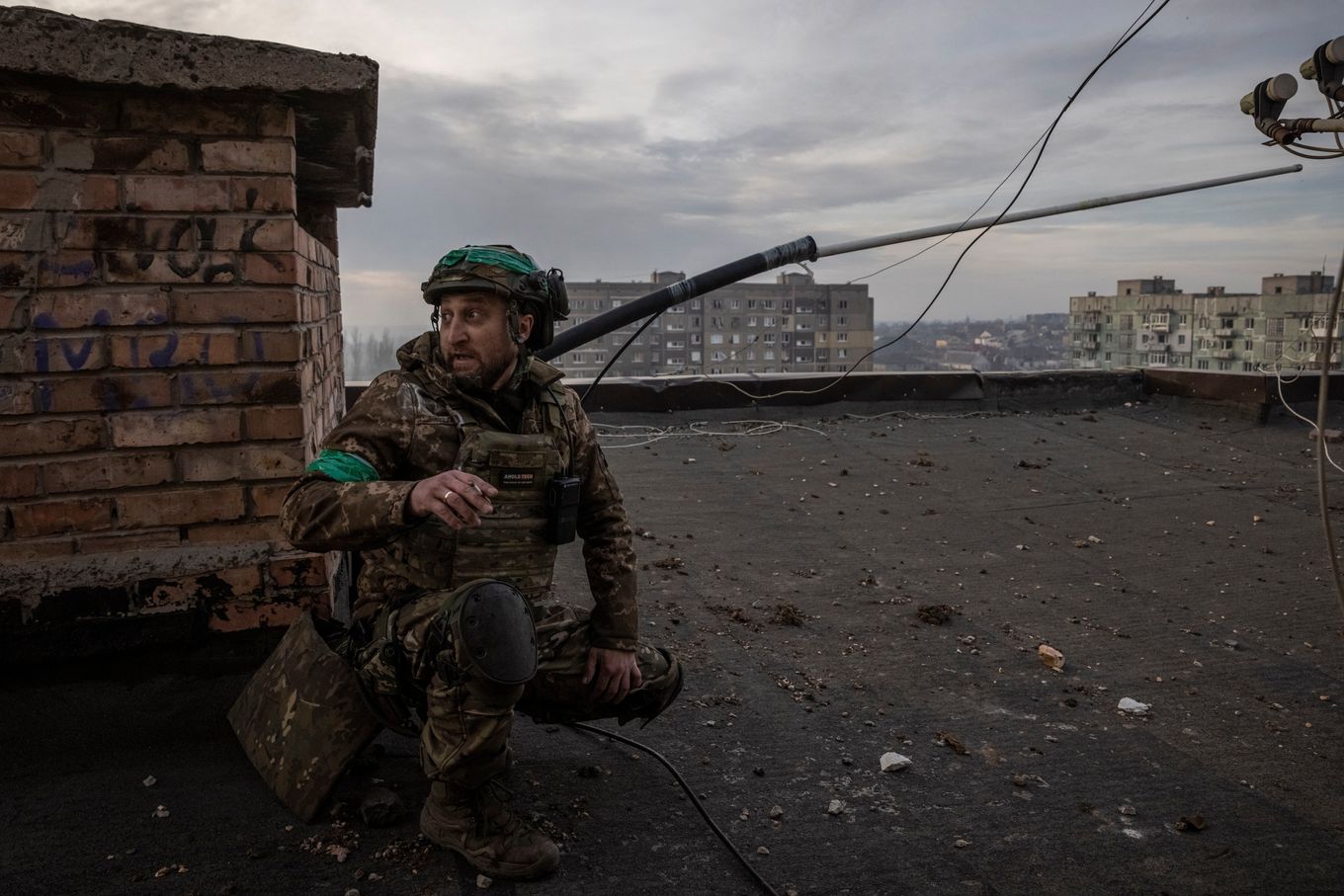 A Ukrainian junior sergeant with the call sign Bandit on top of a destroyed building on Tuesday. (Ed Ram for The Washington Post) A Ukrainian junior sergeant with the call sign Bandit on top of a destroyed building on Tuesday. (Ed Ram for The Washington Post)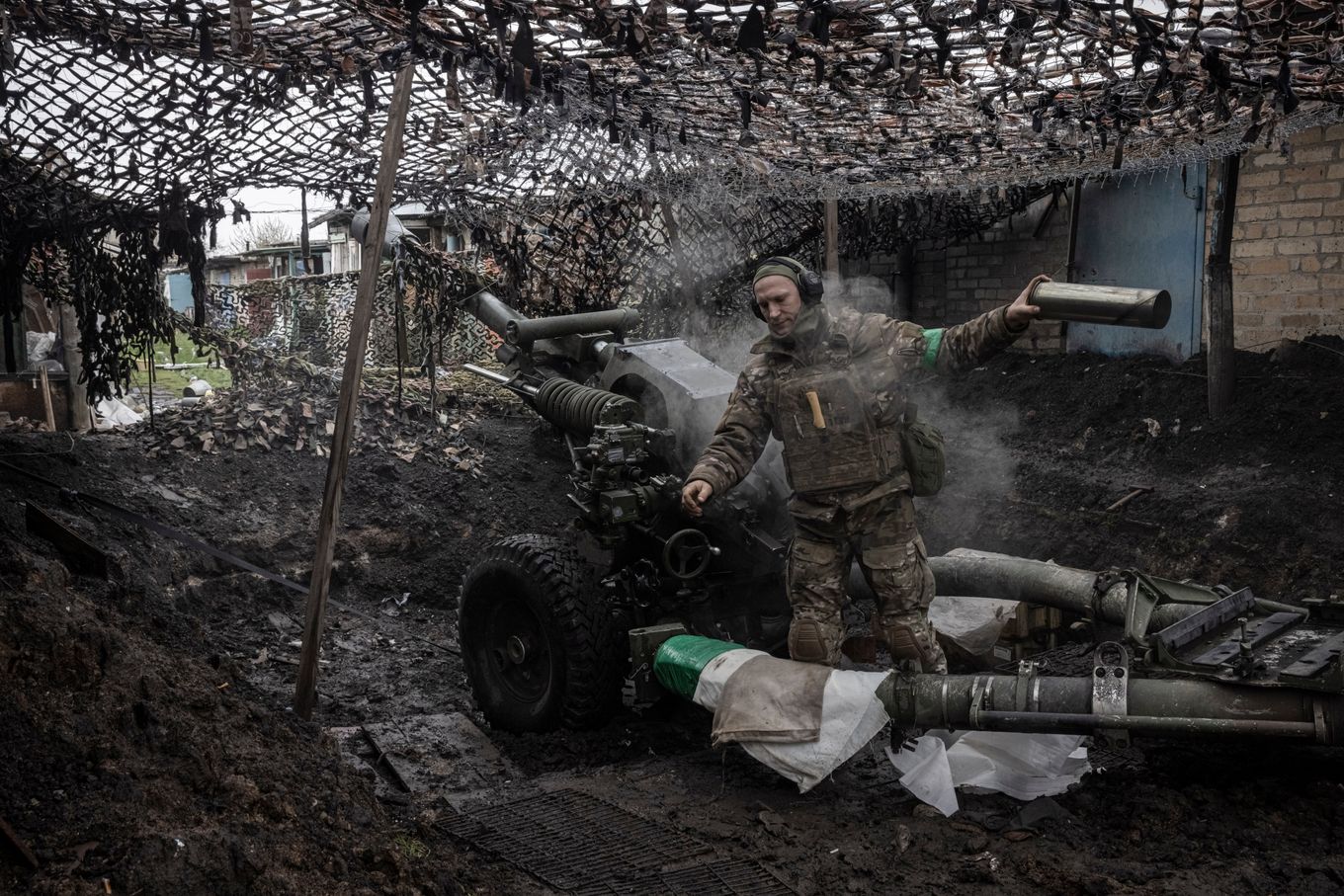 A soldier with the call sign ‘Samurai’ from Ukraine’s 77th Brigade unloads a shell casing after firing a howitzer gun on the outskirts of Chasiv Yar on Friday. (Ed Ram for The Washington Post)For months, Ukraine and Russia have flooded the eastern Ukrainian city of Bakhmut with reinforcements and carted away thousands of dead and wounded in what has become the longest, bloodiest battle of the war. The fight is closing in on just a few square miles of the city’s west, report my colleagues Susannah George and Serhii Korolchuk.As the vise tightens — with Russians assaulting from the north, east and south — Kyiv is determined to draw the fight out as long as possible. Talking Points• Afghanistan has become a significant coordination site for the Islamic State as the terrorist group plans attacks across Europe and Asia, and conducts “aspirational plotting” against the United States, according to a leaked Pentagon assessment that portrays the threat as a growing security concern. The U.S. intelligence findings detailed specific attack planning efforts to target embassies, churches, business centers and the FIFA World Cup soccer tournament.• Another separate trove of leaked documents reveal how Russia has been trying to build an antiwar coalition in Germany that marries the nation’s far right and left. Documents obtained by a European intelligence service and reviewed by The Post record meetings between Kremlin officials and Russian political strategists, and the Kremlin’s orders for the strategists to focus on Germany to build antiwar sentiment in Europe and dampen support for Ukraine. • Foreign powers continued evacuating diplomatic staff from Sudan amid continued fighting. One person was injured when a French diplomatic convoy came under fire. An Egyptian diplomat was also shot and injured. Hundreds of United Nations staffers began a 19-hour exodus by road. Germany began a mission to fly out German nationals — one of the only nations to do so.The U.S. military successfully evacuated American diplomats in an airlift on three MH-47 Chinook helicopters on Saturday. Another 16,000 American citizens who do not work for the government, many of them dual nationals, remain in Sudan. • As deaths pile up amid Iran’s government uprising, funerals and commemorations have become their own form of protest, as well as another grim venue for the state’s systematic crackdown on dissent. The Washington Post analyzed 18 cases of state violence at mourning events and interviewed eyewitnesses, finding visual evidence that national police units and Iran’s Islamic Revolutionary Guard Corps used live fire and less-lethal weapons on mourners. Top of The PostIn a thriving Michigan county, a community goes to war with itselfBy Greg Jaffe and Patrick Marley ● Read more » In wake of Ralph Yarl shooting, Black teens face fear and resignationBy Lauren Lumpkin, Emmanuel Felton and Mark Shavin ● Read more » They endured covid. But some health-care workers mistrust the future.By Dudley M. Brooks and Sandra M. Stevenson ● Read more » ViewpointsWhat happens when a Turkish president loses an election? No one knows.By Reuben Silverman | Foreign Policy ● Read more » Russia hasn’t stopped maneuvering for greater control of the webBy David Ignatius | The Washington Post ● Read more » Postimperial empireBy Timothy Garton Ash | Foreign Affairs ● Read more » Confederation building A soldier with the call sign ‘Samurai’ from Ukraine’s 77th Brigade unloads a shell casing after firing a howitzer gun on the outskirts of Chasiv Yar on Friday. (Ed Ram for The Washington Post)For months, Ukraine and Russia have flooded the eastern Ukrainian city of Bakhmut with reinforcements and carted away thousands of dead and wounded in what has become the longest, bloodiest battle of the war. The fight is closing in on just a few square miles of the city’s west, report my colleagues Susannah George and Serhii Korolchuk.As the vise tightens — with Russians assaulting from the north, east and south — Kyiv is determined to draw the fight out as long as possible. Talking Points• Afghanistan has become a significant coordination site for the Islamic State as the terrorist group plans attacks across Europe and Asia, and conducts “aspirational plotting” against the United States, according to a leaked Pentagon assessment that portrays the threat as a growing security concern. The U.S. intelligence findings detailed specific attack planning efforts to target embassies, churches, business centers and the FIFA World Cup soccer tournament.• Another separate trove of leaked documents reveal how Russia has been trying to build an antiwar coalition in Germany that marries the nation’s far right and left. Documents obtained by a European intelligence service and reviewed by The Post record meetings between Kremlin officials and Russian political strategists, and the Kremlin’s orders for the strategists to focus on Germany to build antiwar sentiment in Europe and dampen support for Ukraine. • Foreign powers continued evacuating diplomatic staff from Sudan amid continued fighting. One person was injured when a French diplomatic convoy came under fire. An Egyptian diplomat was also shot and injured. Hundreds of United Nations staffers began a 19-hour exodus by road. Germany began a mission to fly out German nationals — one of the only nations to do so.The U.S. military successfully evacuated American diplomats in an airlift on three MH-47 Chinook helicopters on Saturday. Another 16,000 American citizens who do not work for the government, many of them dual nationals, remain in Sudan. • As deaths pile up amid Iran’s government uprising, funerals and commemorations have become their own form of protest, as well as another grim venue for the state’s systematic crackdown on dissent. The Washington Post analyzed 18 cases of state violence at mourning events and interviewed eyewitnesses, finding visual evidence that national police units and Iran’s Islamic Revolutionary Guard Corps used live fire and less-lethal weapons on mourners. Top of The PostIn a thriving Michigan county, a community goes to war with itselfBy Greg Jaffe and Patrick Marley ● Read more » In wake of Ralph Yarl shooting, Black teens face fear and resignationBy Lauren Lumpkin, Emmanuel Felton and Mark Shavin ● Read more » They endured covid. But some health-care workers mistrust the future.By Dudley M. Brooks and Sandra M. Stevenson ● Read more » ViewpointsWhat happens when a Turkish president loses an election? No one knows.By Reuben Silverman | Foreign Policy ● Read more » Russia hasn’t stopped maneuvering for greater control of the webBy David Ignatius | The Washington Post ● Read more » Postimperial empireBy Timothy Garton Ash | Foreign Affairs ● Read more » Confederation building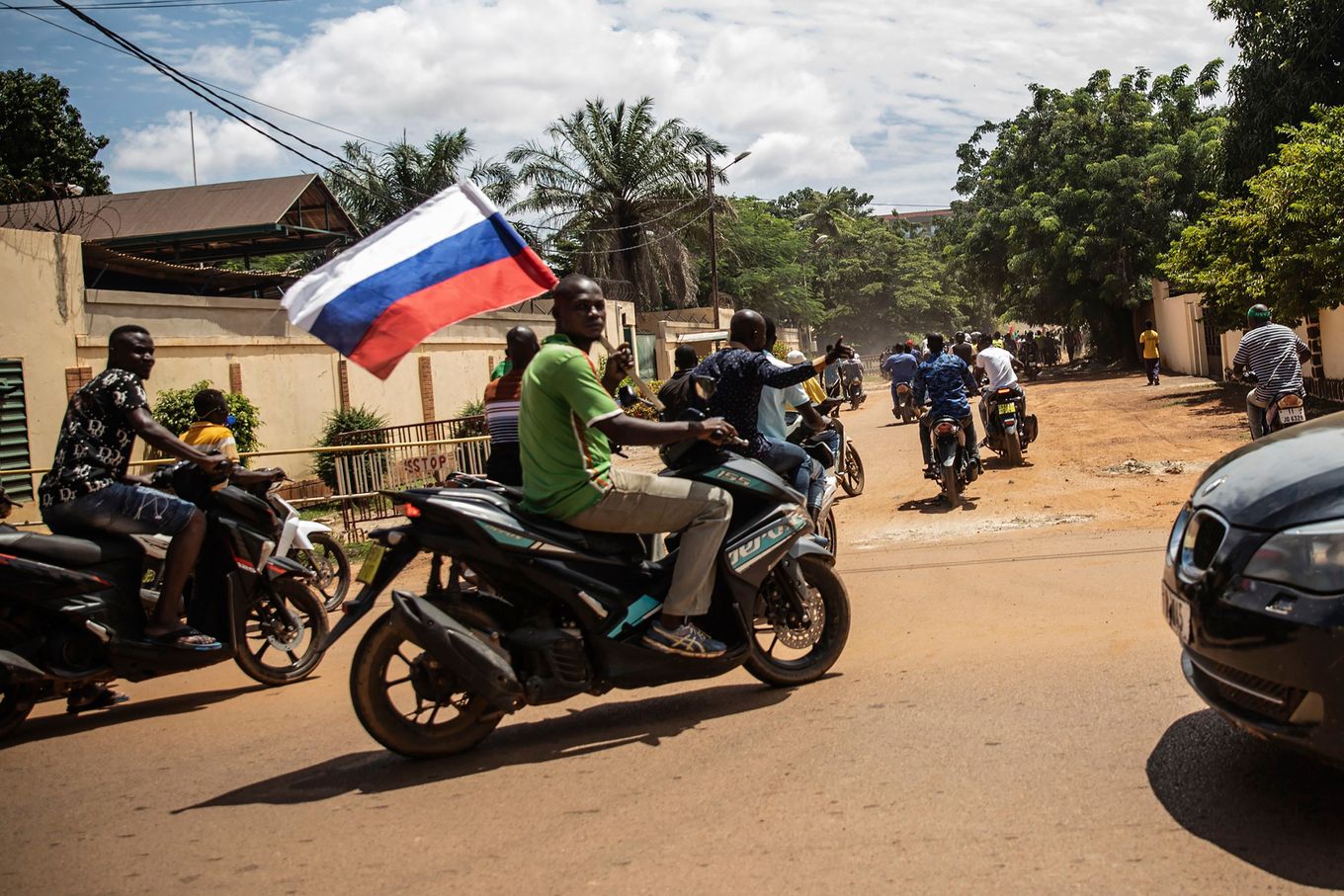 Supporters of a military junta wave a Russian flag in the streets of Ouagadougou, Burkina Faso, on Oct. 2. (Sophie Garcia/AP)The Wagner Group is moving aggressively to establish a “confederation” of anti-Western states in Africa as the Russian mercenaries foment instability while using their paramilitary and disinformation capabilities to bolster Moscow’s allies, according to leaked secret U.S. intelligence documents.The rapid expansion of Russia’s influence in Africa has been a source of growing alarm to U.S. intelligence and military officials, prompting a push over the past year to find ways to hit Wagner’s network of bases and business fronts with strikes, sanctions and cyber operations, according to the documents.At a time when Wagner leader Yevgeniy Prigozhin has been preoccupied with Kremlin infighting over the paramilitary group’s deepening involvement in the war in Ukraine, U.S. officials depict Wagner’s expanding global footprint as a potential vulnerability.One document in the trove lists nearly a dozen “kinetic” and other options that could be pursued as part of “coordinated U.S. and allied disruption efforts.” The files propose providing targeting information to help Ukraine forces kill Wagner commanders, and cite other allies’ willingness to take similar lethal measures against Wagner nodes in Africa.And yet, there is little in the trove to suggest that the CIA, Pentagon or other agencies have caused more than minor setbacks for Wagner over a six-year stretch during which the mercenary group, controlled by Putin ally Prigozhin, gained strategic footholds in at least eight African countries, among 13 nations where Prigozhin has operated in some capacity, according to one document.The only direct military strike mentioned in the files refers to “a successful unattributed attack in Libya” that “destroyed a Wagner logistics aircraft.” The document provides no further detail about the operation or why that single plane — part of a far larger Wagner fleet — was targeted.The most significant American attack against Wagner was near Deir al-Zour, Syria, in February 2018, when U.S. airstrikes killed several hundred Wagner fighters who were attacking several dozen Delta Force soldiers, Rangers and Kurdish forces next to a gas plant. Supporters of a military junta wave a Russian flag in the streets of Ouagadougou, Burkina Faso, on Oct. 2. (Sophie Garcia/AP)The Wagner Group is moving aggressively to establish a “confederation” of anti-Western states in Africa as the Russian mercenaries foment instability while using their paramilitary and disinformation capabilities to bolster Moscow’s allies, according to leaked secret U.S. intelligence documents.The rapid expansion of Russia’s influence in Africa has been a source of growing alarm to U.S. intelligence and military officials, prompting a push over the past year to find ways to hit Wagner’s network of bases and business fronts with strikes, sanctions and cyber operations, according to the documents.At a time when Wagner leader Yevgeniy Prigozhin has been preoccupied with Kremlin infighting over the paramilitary group’s deepening involvement in the war in Ukraine, U.S. officials depict Wagner’s expanding global footprint as a potential vulnerability.One document in the trove lists nearly a dozen “kinetic” and other options that could be pursued as part of “coordinated U.S. and allied disruption efforts.” The files propose providing targeting information to help Ukraine forces kill Wagner commanders, and cite other allies’ willingness to take similar lethal measures against Wagner nodes in Africa.And yet, there is little in the trove to suggest that the CIA, Pentagon or other agencies have caused more than minor setbacks for Wagner over a six-year stretch during which the mercenary group, controlled by Putin ally Prigozhin, gained strategic footholds in at least eight African countries, among 13 nations where Prigozhin has operated in some capacity, according to one document.The only direct military strike mentioned in the files refers to “a successful unattributed attack in Libya” that “destroyed a Wagner logistics aircraft.” The document provides no further detail about the operation or why that single plane — part of a far larger Wagner fleet — was targeted.The most significant American attack against Wagner was near Deir al-Zour, Syria, in February 2018, when U.S. airstrikes killed several hundred Wagner fighters who were attacking several dozen Delta Force soldiers, Rangers and Kurdish forces next to a gas plant.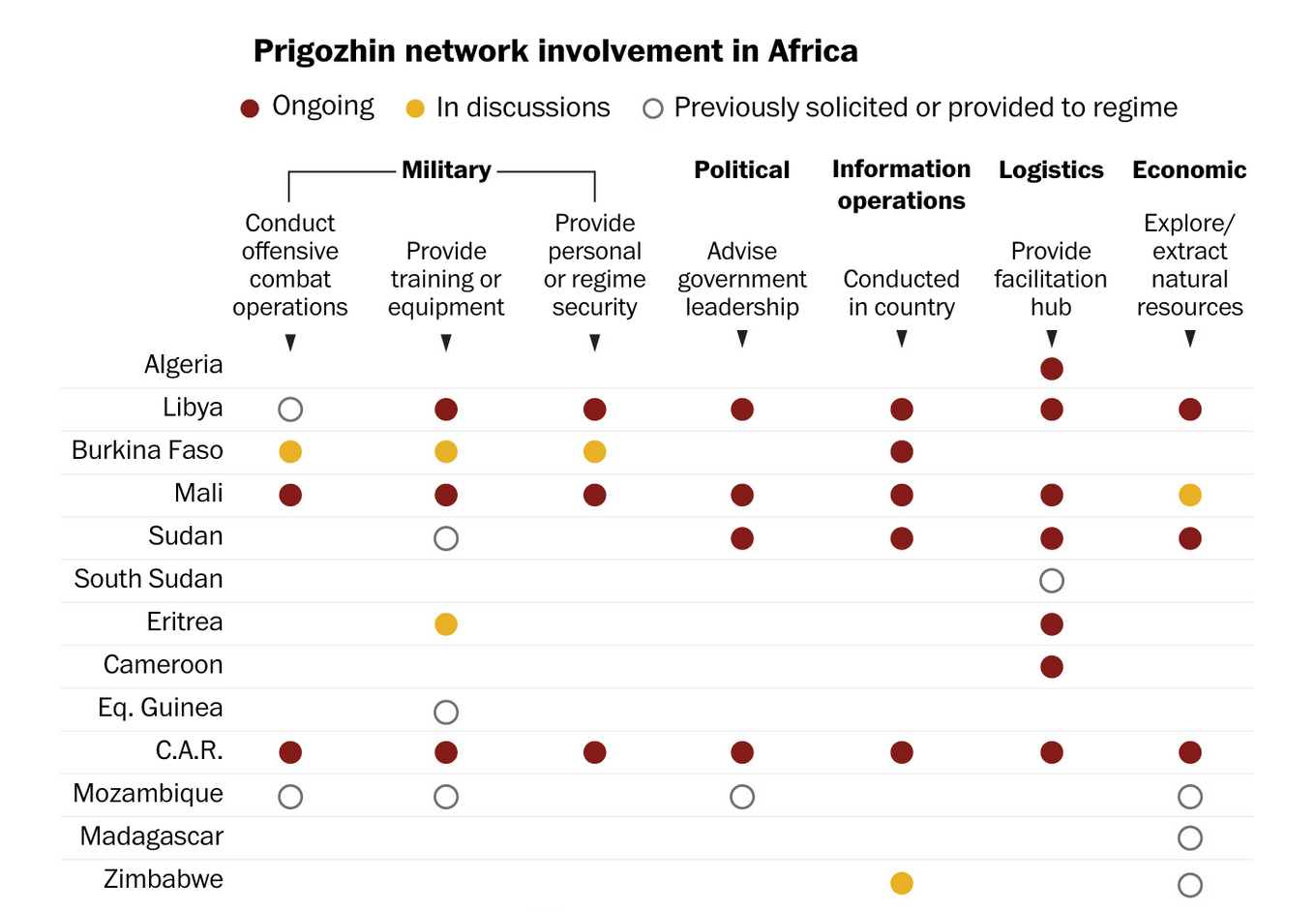 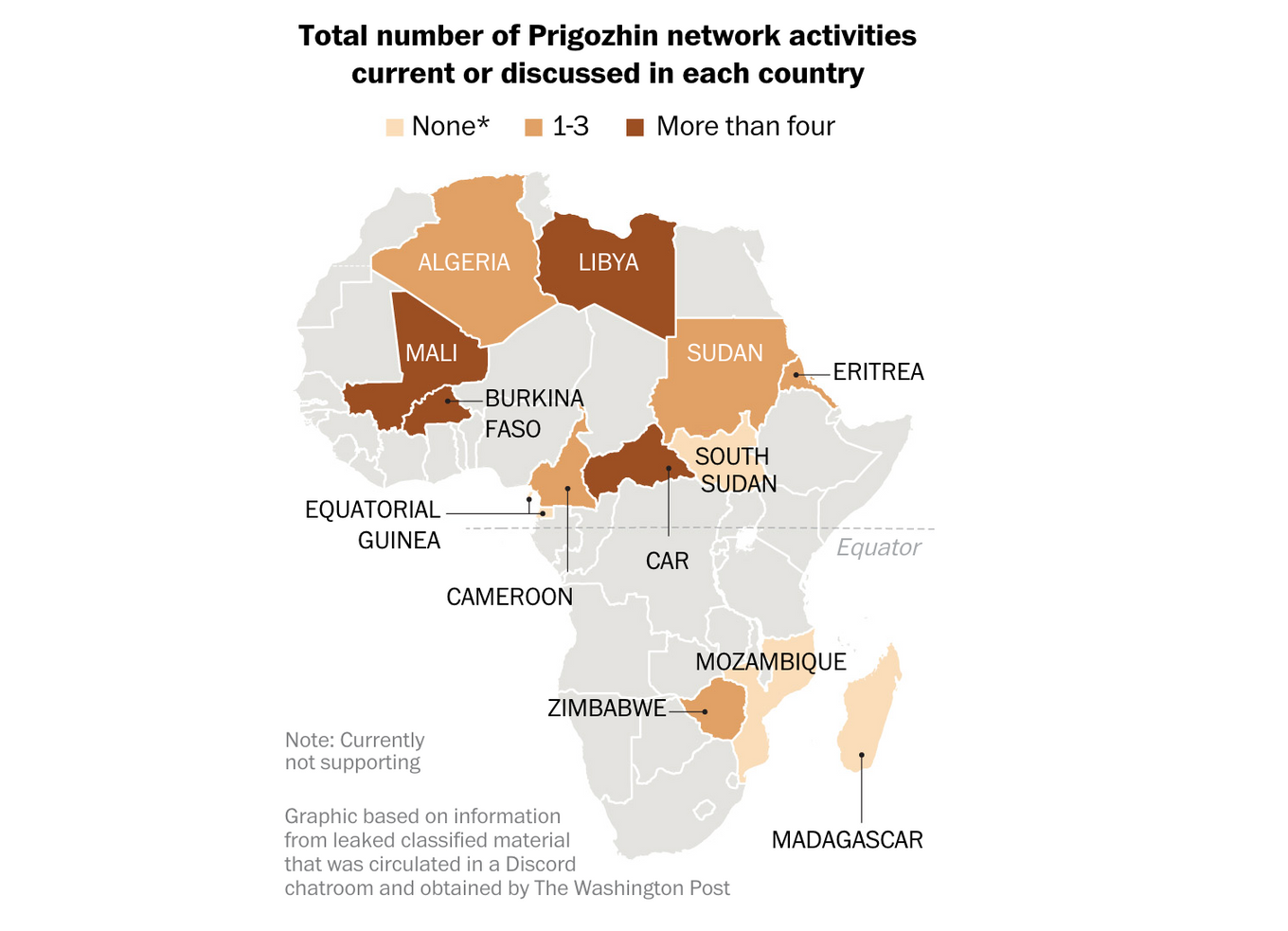 Overall, the trove portrays Wagner as a relatively unconstrained force in Africa, expanding its presence and ambitions on that continent even as the war in Ukraine has become a grinding, if not all-consuming, problem for the Kremlin.As a result, “Prigozhin likely will further entrench his network in multiple countries,” one of the intelligence documents concludes, “undermining each country’s ability to sever ties with his services and exposing neighboring states to his destabilizing activities.”Wagner’s rise heralds a new surge of great power competition in Africa and with it a resurgence of authoritarianism, said Anas El Gomati, director of the Tripoli-based Sadeq Institute think tank. Wagner, he said, “are a solution to the kind of problems that African dictators find themselves in: Democratic pushback? No problem. We’ll help you with that, whether it’s tampering with ballots, or whether it’s literally fighting brutal kind of insurgencies like they have in [the Central African Republic] and in southern Libya.”“If you’re suffering trying to get your resources and minerals out of your country, ‘not only can we bring [those] services to you, but we’ll put those dollars in your bank and no one will be any the wiser’ — because they operate these massive networks of shell companies,” he said, referring to Wagner. – Greg Miller and Robyn Dixon. Overall, the trove portrays Wagner as a relatively unconstrained force in Africa, expanding its presence and ambitions on that continent even as the war in Ukraine has become a grinding, if not all-consuming, problem for the Kremlin.As a result, “Prigozhin likely will further entrench his network in multiple countries,” one of the intelligence documents concludes, “undermining each country’s ability to sever ties with his services and exposing neighboring states to his destabilizing activities.”Wagner’s rise heralds a new surge of great power competition in Africa and with it a resurgence of authoritarianism, said Anas El Gomati, director of the Tripoli-based Sadeq Institute think tank. Wagner, he said, “are a solution to the kind of problems that African dictators find themselves in: Democratic pushback? No problem. We’ll help you with that, whether it’s tampering with ballots, or whether it’s literally fighting brutal kind of insurgencies like they have in [the Central African Republic] and in southern Libya.”“If you’re suffering trying to get your resources and minerals out of your country, ‘not only can we bring [those] services to you, but we’ll put those dollars in your bank and no one will be any the wiser’ — because they operate these massive networks of shell companies,” he said, referring to Wagner. – Greg Miller and Robyn Dixon. |