
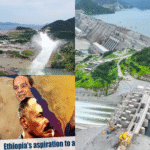

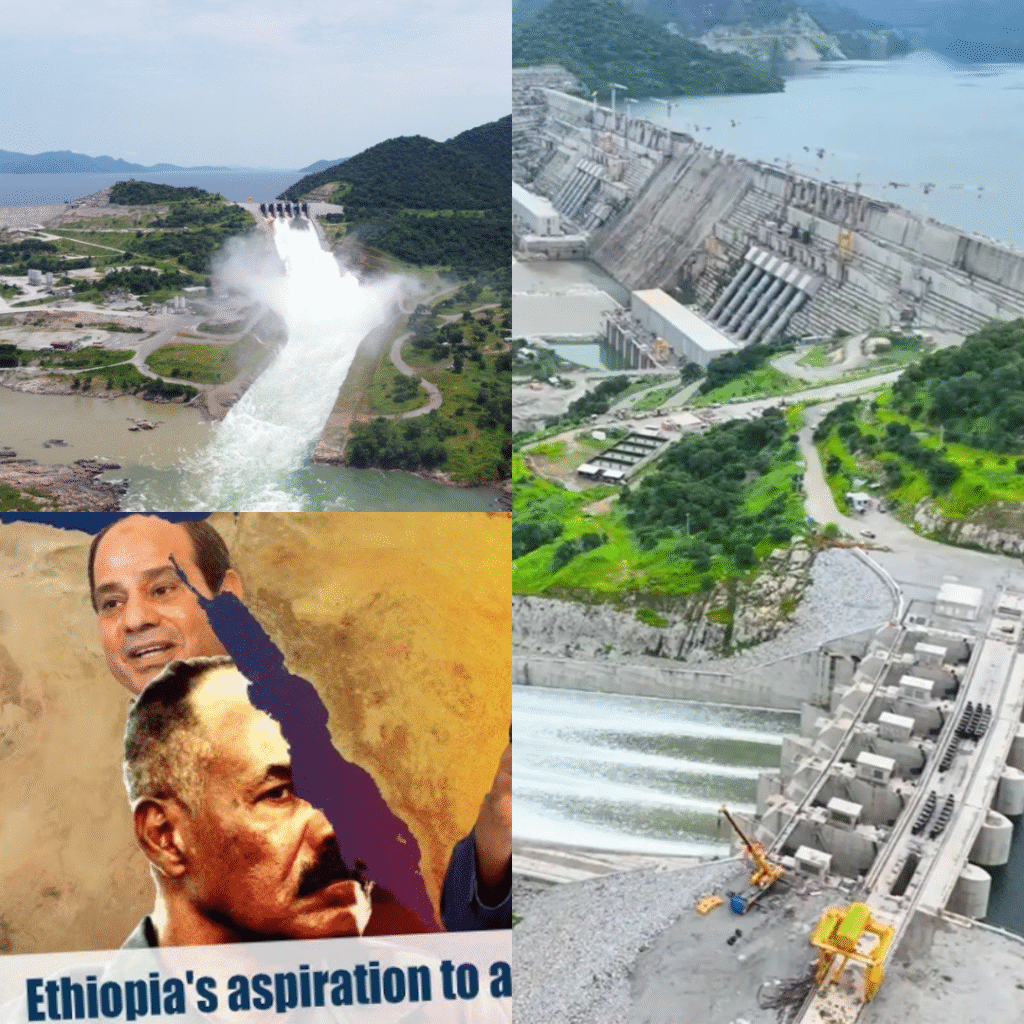
The dam was the battle; the sea is the horizon !!
Introduction: The Phoenix from the Ashes of Sabotage
They said it was a fool’s errand. For over a decade, the Grand Ethiopian Renaissance Dam (GERD) was a monument not just to concrete and ambition, but to a nation’s resilience in the face of a perfect storm of opposition. It was David, not just against one Goliath, but against a chorus of them. From the hallowed halls of the United Nations to the diplomatic salons of Cairo and Khartoum, from financial strangleholds to veiled threats, the message was clear: This river is not yours to command.
But Ethiopia listened to a different rhythm—the ancient pulse of the Blue Nile, a river that springs from its highlands, yet whose bounty it was historically denied. The nation embarked on a journey that would become a modern-day parable of defiance and determination. The completion of the GERD is not merely an engineering feat; it is a geopolitical earthquake whose tremors are reshaping the Horn of Africa and beyond. It is the proof that a river cannot be held hostage forever, and neither can a nation’s destiny. As the Roman poet Virgil once wrote, “They can because they think they can.” Ethiopia thought it could, and so it did.
The Siege and the Sacrifice: A Decade of Defiance
The story of the GERD is etched in the collective memory of Ethiopians. It is a narrative punctuated by what can only be described as a multi-dimensional sabotage.
· The Financial Blockade: International financial institutions, under immense political pressure, turned their backs. The World Bank and others refused funding, a move designed to starve the project in its cradle. Ethiopia’s response was nothing short of heroic: a nationwide mobilization. As the Qur’an inspires in Surah Al-Baqarah (2:286), “Allah does not charge a soul except [with that within] its capacity.” Ethiopia bore the charge. Government bonds were bought by farmers and civil servants, students donated their pocket money, and the diaspora poured in millions—a powerful testament to a people financing their own future. It called to mind the words of Winston Churchill: “We make a living by what we get, but we make a life by what we give.” An entire nation gave, and in doing so, built more than a dam; they built a legacy.
· The Diplomatic Onslaught: Egypt, wielding historical treaties like the 1929 and 1959 agreements forged in the era of colonialism, campaigned relentlessly to internationalize the issue. They framed the dam as an “existential threat,” leveraging their diplomatic weight across the Arab world and in Western capitals. It was a battle of narratives, where Ethiopia had to fight to establish a simple, yet profound truth: the right to use one’s own water is a cornerstone of sovereignty. In the face of this, Ethiopia stood as a modern-day embodiment of William Ernest Henley’s Invictus: *”In the fell clutch of circumstance / I have not winced nor cried aloud. / Under the bludgeonings of chance / My head is bloody, but unbowed.”
· The Cyber and Propaganda Wars: Shadowy cyber-attacks aimed at disrupting the project’s infrastructure and a relentless media campaign sought to paint Ethiopia as an irresponsible upstream actor.
Through it all, Ethiopia stood firm. The nation became a living embodiment of the Igbo proverb: “When the moon is not full, the stars shine brighter.” In the absence of international support, the light of its people’s resolve shone with blinding intensity. It was a clear case of what the French philosopher Albert Camus observed: “In the depth of winter, I finally learned that within me there lay an invincible summer.”
The Tipping Point: The New Geopolitical Calculus
The moment the GERD’s turbines began to spin, the geopolitical landscape of the Horn of Africa shifted irrevocably. The dam is no longer a proposal; it is a fait accompli, a towering reality that cannot be wished away.
1. Energy Sovereignty: With a potential to generate over 5,250 MW of electricity, Ethiopia transforms from a power-deficient nation into the “battery of East Africa.” This is not just about lights in homes; it is about powering industries, attracting foreign investment, and fueling an economic renaissance. It grants Addis Ababa unprecedented leverage and independence. This is the tangible fruit of perseverance, echoing the Biblical promise in Galatians 6:9: “Let us not become weary in doing good, for at the proper time we will reap a harvest if we do not give up.”
2. Regional Realignment: Gulf nations, specially those frequently mentioned by several experts, i.e., Qatar, Kuwait, and the like, who once may have been swayed by Cairo’s narrative, now see a different Ethiopia—a formidable regional power and a crucial partner in a volatile region. Their investments and strategic interests now necessitate a balanced relationship with Addis Ababa, one that acknowledges its new-found strength. The great strategist Sun Tzu’s words ring true: “The supreme art of war is to subdue the enemy without fighting.” Ethiopia subdued a decade of opposition not with arms, but with unwavering resolve.
3. The Demise of the Veto: Egypt’s greatest loss is its power to veto Ethiopia’s development. The decades-long strategy of obstruction has collapsed. As the Biblical verse in Ecclesiastes (3:1) states, “To every thing there is a season, and a time to every purpose under the heaven.” The season of Egyptian hydro-hegemony over the Nile is drawing to a close. The Greek philosopher Heraclitus famously said, “The only constant in life is change.” Ethiopia has become the author of that change.
The Inevitable Tide: From Hydro-Power to a Sovereign Anchor
Leveraging this hard-won momentum, Ethiopia’s ancient quest for sovereign sea access is no longer a romantic dream but a strategic imperative whose time has come. The completion of the GERD is the key that unlocks this next chapter. This is about securing a nation’s strategic depth. The goal is a sovereign anchor in the Red Sea—a gateway for commerce safeguarded by the sovereign right to defend it, ensuring that Ethiopia’s economic lifeline can never be held hostage again.
Why is a sovereign port, with its necessary security component, now a plausible reality?
· The Shift in Leverage:
Cairo is no longer dealing with a supplicant, but a peer. The GERD gives Ethiopia a powerful card in any future negotiation. Water, the lifeblood of Egypt, is now a subject of negotiation, not just dictation. A grand bargain is conceivable: Guaranteed, predictable water flows from the GERD in exchange for a new Egyptian grateful policy towards Ethiopia, so as to even align with Ethiopia’s moves in securing a sovereign corridor to the red sea with a defensive presence. This is the essence of realpolitik, a dance of mutual interest where, as the Qur’an suggests in Surah An-Nahl (16:90), “Indeed, Allah orders justice and good conduct.” A just solution that guarantees security for both nations is within reach.
· A Lesson from History and Geostrategy: The world’s great powers have long understood that commerce without security is a precarious endeavor. From the British Empire’s need for Gibraltar and Suez to the United States’ global network of naval bases, sovereign access implies the right to defend that access. For Ethiopia, a landlocked nation that has felt the stranglehold of closed borders, this is not aggression; it is the logical and necessary conclusion of its renaissance. It is the embodiment of the ancient Roman adage, “Si vis pacem, para bellum”—”If you want peace, prepare for war.” A sovereign post ensures peace by deterring conflict. This is not a newly invented ambition. The Ethiopian empire historically had ports like Massawa and Assab, lost through the tumult of history. Reclaiming a sovereign outlet is a restoration of a historical right, a closing of a painful geopolitical circle.
· A New Pillar of Regional Stability: A sovereign Ethiopian presence in the Red Sea would not be a destabilizing force, but a stabilizing one. It would provide a powerful, indigenous naval partner to help secure one of the world’s most critical shipping lanes from piracy, terrorism, and the influence of distant powers. It is in the interest of regional stability. As the great Ethiopian Emperor Menelik II once stated, “I have no intention of being an indifferent spectator if the distant Powers have the notion of dividing up Africa.” Today’s Ethiopia has no intention of being an indifferent spectator to the security of its own economic and strategic future.
Conclusion: The Dawn of a New Chapter
The GERD stands today as a silent, powerful orator. It speaks of a nation that stared down adversity and won. It has rewritten the rules of engagement in one of the world’s most volatile regions. The dam has, in essence, conditioned Cairo for this very conversation. The once-unthinkable—Egypt accepting an Ethiopian sovereign port and strategic post on the Red Sea—is now a matter of hard-nosed realpolitik. The alternative—perpetual tension and the uncertainty of a powerful, frustrated, and still landlocked neighbor—is far less palatable.
The journey of the Nile, from the Ethiopian highlands to the Mediterranean, is a long one. For centuries, Ethiopia watched its waters flow out, powerless to harness their potential. No longer. The river that was once a source of contention has become a source of unparalleled strength. And just as the Nile carves its path unceasingly to the sea, so too will Ethiopia, propelled by the current of its own renaissance, find its way back to the waves—this time, not as a guest, but as a sovereign power.
The dam was the battle; the sovereign shore is the prize.
In the end, the words of the Ethiopian people themselves, through their triumph, shout the timeless truth found in the Bible’s Book of Isaiah (43:19): “See, I am doing a new thing! Now it springs up; do you not perceive it? I am making a way in the wilderness and streams in the wasteland.” The GERD is that new thing; the path to the sea is that way in the wilderness.

