

By, Michelle Gavin, May 3, 2023
International re-engagement and new peace talks point in a positive direction, but multiple indicators point to fragility and risk.
As the world watches Sudan’s unraveling with horror, progress in neighboring Ethiopia can make the country seem like a relatively bright spot on a troubled map. The war in Tigray is over, the peace there is holding, and the government recently commenced new talks with the Oromo Liberation Army. The state has pivoted away from rhetoric demonizing its longtime development partners and toward messages embracing re-engagement and getting the country’s economic trajectory back on track—a practical choice given the country’s debt crisis, recent years’ massive military spending, and the resulting staggering reconstruction needs.
All of this positive momentum is welcome. Not long ago the world was confronted with the possibility of state collapse in Ethiopia. Now, observers are reminded that a prosperous and peaceful Ethiopia would be a boon to the region and ultimately a formidable force for elevating African priorities globally. But there are other, less encouraging developments unfolding that indicate just how much fragility lurks below the surface.
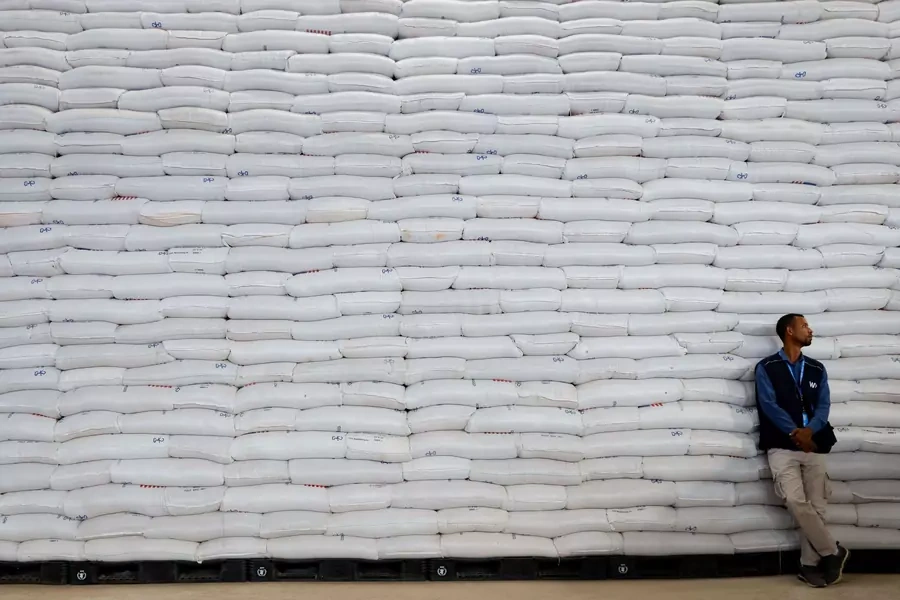
In Tigray itself, the war may be over, but the suffering is not. Credible reports indicate that the peace agreement has not stopped forced displacements in contested areas of the region. The presence of Eritrean forces, and Amhara militia, persists. Despite desperate need, the World Food Program suspended aid deliveries to Tigray in the wake of allegations that substantial theft has diverted food from reaching the hungry.
Africa in Transition
Michelle Gavin, Ebenezer Obadare, and other experts track political and security developments across sub-Saharan Africa. Most weekdays.Email Address
Setting Tigray aside, humanitarian access is difficult, or currently impossible, in large swathes of the country. Citizens are restricted from accessing social media. Journalists continue to be subject to arbitrary arrest and harassment. These centralized efforts to assert control can be counterproductive, fueling more suspicion and resentment. They certainly do not comport with the confidence Ethiopia’s leaders aim to project.
Last week’s murder of Girma Yeshitila, a senior figure in Prime Minister Abiy’s Prosperity Party, is indicative of the tensions still simmering in Ethiopia. The incident comes on the heels of widely publicized divisions within the Orthodox Church, an important moral authority for many Ethiopians, and in the wake of resistance to Addis Ababa’s initiative to integrate regional security forces into federal structures. Ethiopia’s federal government is engaged in a high wire act; trying to consolidate power and move forward despite the rifts in Ethiopian society made wider by the Tigray conflict, and managing the sense among some of Abiy’s allies that they deserve a greater share of the victors’ spoils. It’s clear that authorities are aware of the threat that ethnic nationalists, so recently encouraged by federal leaders, now present. In the aftermath of the killing, Ethiopia claimed to have arrested forty-seven people involved in a wider plot to overthrow the state.
As Ethiopia moves in two directions at once, the United States has its own difficult balancing act to perform. Positive developments deserve support, but the trouble in Ethiopia will not go away if we simply pretend not to see it. If there is any consensus on how external actors failed Sudan in recent years, it revolves around the notion that ignoring uncomfortable realities and believing commitments of dubious credibility are recipes for policy failure. Washington should proceed with caution, looking for concrete indicators that Ethiopian politics are normalizing, that decision-makers are not beholden to malign actors, that civil and political rights are being respected, and that leaders’ public commitments are matched by developments on the ground.
A “New Scramble for Africa”?
When a phraseology says more about its users than the reality it purports to describe.

Blog Post by Ebenezer Obadare
May 2, 2023 9:27 am (EST)
If a section of the Western media is to be believed, ongoing great power competition for diplomatic influence and natural resources in Africa is nothing but another desperate “scramble” in which the vital strategic interests of the continent and its peoples can be expected to receive the usual short shrift.
That this sense of history tragically repeating itself on the continent is widely shared by many African intellectuals and students of Africa goes without saying. Uniting this disparate group is a legitimate concern for Africa’s well-being and a genuine desire to ensure that, when the dust from the current moment inevitably settles, its peoples do not, yet again, end up with the short end of the global diplomatic stick.
To the extent that those deploying the language of a “new scramble” are motivated by a concern for the continent’s well-being, it is difficult to fault them. Yet, the question must be asked as to whether their reading of the African situation is correct, and whether indeed the current formation in the region warrants the tag of a “scramble”.
Africa in Transition
Michelle Gavin, Ebenezer Obadare, and other experts track political and security developments across sub-Saharan Africa. Most weekdays.Email Address
Over the past two decades, in a tale of diplomatic ebbs and flows, the United States, China, and Russia have struggled to recruit and maintain allies in Africa. While none of these powers is exactly new to the continent, China’s economic rise, and its evident determination to knock the United States off its global pedestal, has raised the geopolitical stakes. Russia, lacking China’s economic muscle, has embraced the role of spoiler to Western interests. Both have turned “non-interference” in the domestic politics of their African allies into a virtue. Insofar as the Russian invasion of Ukraine has helped to expose these emergent fault lines, the fragmented African reaction to the war has revealed levels of diplomatic astuteness not normally associated with global subalterns.
In short, the image of a “scramble” in which helpless African states are exploited and manipulated by global powers who care nothing for their welfare hardly stands up to scrutiny. On the contrary, there is evidence that many African countries see an opportunity to play the United States, China, and Russia—not to mention non-traditional powers like India, Turkey, Saudi Arabia, and the United Arab Emirates (UAE) among others—against one another. In other words, African states are, as states tend to do, making various calculations based on their perception of what is right or wrong for them. This is not to deny that they have ideological or moral preferences (they do as a matter of fact, but that is not my focus here); it is to insist that African countries are not mere pawns totally lacking in agency, hence at the mercy of those who would shuffle them around the diplomatic chessboard. From this standpoint, the real debate to be had is not whether African countries control their own diplomatic destiny, but how their agency, which is ever present, is being exercised.
If the geopolitical reality on the continent contradicts the image of a “scramble,” why have sections of the media and the African intelligentsia persevered in their unreflective and downright condescending embrace of it? What is the philosophical provenance of this mental reflex?
Fundamentally speaking, it is the logical outcome of an imaginary in which Africa, an entity deserving nothing less than our constant pity, is always on the receiving end. This is the only plausible explanation for the assumption that because global power competition is taking place in Africa, the continent is thereby being shortchanged. In this infantilizing zero-sum imagination, a struggle for resources in Africa automatically means scarcity for African peoples, as if, somehow, African states cannot trade natural resources and keep some for their own use and benefit at the same time.
It takes a certain amount of paternalism and ignorance of history to assume that Africa today is the same as Africa circa 1884, but such is the gall and moral certainty of those who must put their desire to save Africa ahead of the imperative to understand it. If the classical libel against Africa is that it has no history, the contemporary equivalent is that that history never changes.
What was true then remains true now: Africa has more to worry about from its friends than its adversaries.

