Written by Faith Chelangat
Introduction
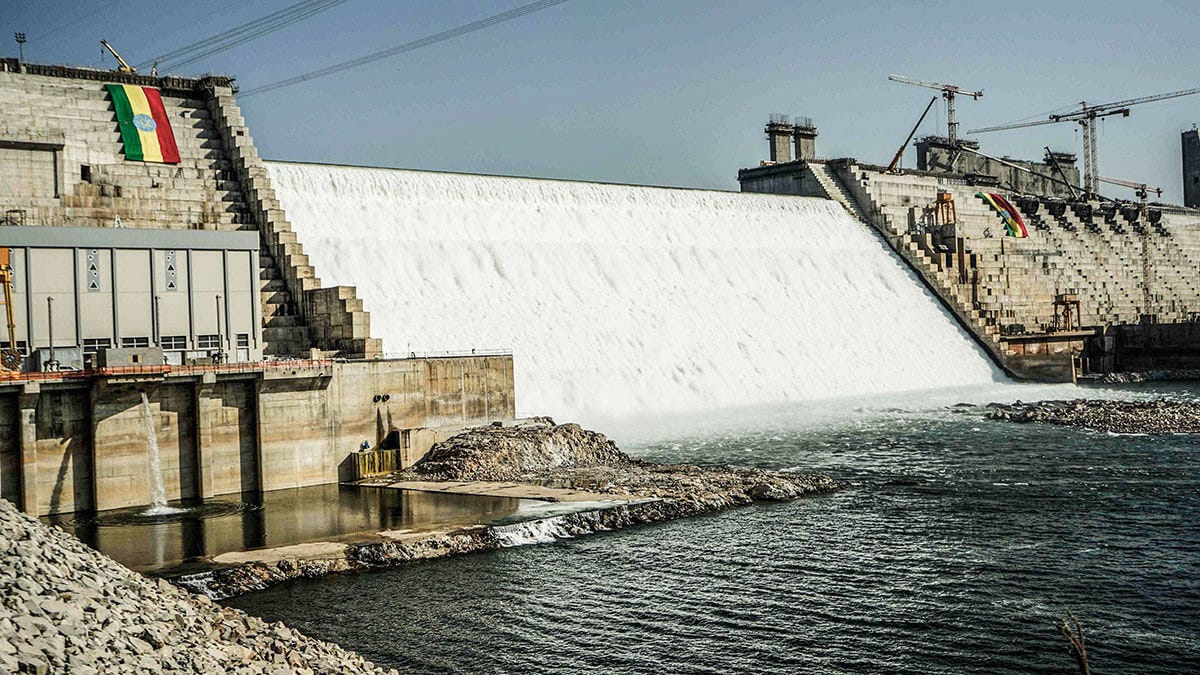
Situated on the Blue Nile River, the Grand Ethiopian Renaissance Dam (GERD) project has emerged as a fissure of sustained geopolitical tensions within Northeast Africa since 2011, pitting Ethiopia, Egypt and Sudan against one another. The Ethiopian government took on the project in 2011 at a time when Egypt, which had been opposing Ethiopia’s activities on the Nile, was faced with severe internal conflict emerging from the Arab Spring that culminated in the revolutionary ouster of then-president Hosni Mubarak from power[1]. This dam is expected to become Africa’s biggest hydroelectric power project, producing 6000 MW of power along with a storage volume of 74 billion cubic meters of water once completed[2]. The world’s longest river, the Nile, traverses eleven countries, all of which have varying interests as to how this resource should be used. Egypt, Ethiopia and Sudan are of particular interest, since their interests as they relate to the Nile are classified as “very high”[3]. This highlights the fact that Ethiopia stands to gain economically from this large hydroelectric project. Its efforts to establish the GERD have been supported by the Intergovernmental Authority on Development (IGAD), whose staff made a direct contribution of USD $250,000 towards the project’s progression[4]. IGAD, whose member states include Ethiopia and other Horn of Africa nation states, is a regional body responsible for overseeing development, drought mitigation, food security and conflict management among its members.
However, Egypt in particular has been a staunch opponent of the dam, voicing worries regarding water security and regional stability. The building and operation of this grand dam wields far-reaching effects that go beyond simple water management, spilling into matters of regional power dynamics, economic development and national sovereignty. This essay explores the impact of the GERD project on the water politics of the Nile River, its implications for regional security and lost opportunities that, if harnessed, would significantly minimize the political and security tensions in Northeast Africa and the Horn of Africa due to the unilateral construction of the GERD.
The contestation over the GERD project between Egypt, Sudan and Ethiopia: Impact on water politics
As the main proponent of the GERD project, Ethiopia sees the dam as an essential step toward achieving energy security and economic development. Like the Intergovernmental Authority on Development (IGAD), it continues to highlight the project’s many benefits to the region — including to Egypt. From Ethiopia’s perspective, this grand dam is the much-needed key to altering the nation’s current state of poverty alongside its continued problem of restricted access to electricity, two issues that have long plagued the nation[5]. As Africa’s biggest hydropower project, Ethiopia believes the GERD unlocks its potential to become the continent’s most significant exporter of power, which aligns with the country’s quest for growing its influence in the region.
On the other hand, Egypt is skeptical of the GERD project, which it considers an existential threat to its national survival particularly considering that historically, it has often relied almost entirely on the Nile River for its water needs. Egypt’s opposition to GERD largely rests on the argument that since 97 percent of its freshwater needs are provided by the Nile River, its overall water security could be under serious threat[6]. From the outset, water politics took center stage with both Egypt and Sudan strongly protesting the dam’s construction. Both countries were concerned that it would significantly decrease their access to Nile River waters considering the water flows from Ethiopia through Sudan into Egypt. Egypt’s argument was that the GERD would potentially turn its irrigated tracts of land into desert and significantly lower its hydropower generation at the Aswan High Dam[7]. Sudan, which is sandwiched between Ethiopia and Egypt, initially opposed the GERD, but it later welcomed the project after its politicians and professionals informed their citizenry that the GERD would potentially benefit Sudan by trapping sediments annually carried by the Blue Nile into the country[8]. The GERD was also welcome by Sudan since it would also prevent flooding, crop and property destruction that the country had been experiencing during the seasonal overflow of the Blue Nile[9]. It is in this light that Sudan became more receptive towards Ethiopia’s construction of the GERD.
It is also crucial to point out that the GERD project also brought to light the existing shortcomings of current international water law with regards to resolving disputes pertaining to the contested utilization of shared waters. Ethiopia and many other upstream nations such as Uganda, Kenya, Tanzania, Rwanda, Burundi and the Democratic Republic of Congo were left out of the 1959 Nile Waters Agreement, which gave Egypt and Sudan exclusive rights to the majority of the Nile’s water[10]. In that regard, discussions concerning fair water usage in transboundary river basins have been triggered by Ethiopia’s rejection of this agreement and its claim that it has the right to use the Nile’s waters for its own development. As a consequence, Egypt’s claim to authority over the control of the Nile waters remains challenged and it remains to be seen whether the several treaties that long bestowed upon Egypt a monopoly over Nile waters will hold at a time when Ethiopia is deliberately disregarding them through GERD’s establishment.
Wider political and security implications of the GERD: Implications for regional stability
Regional tensions are no longer merely a contestation for the Nile waters per se, they have also spilled over into other equally important geopolitical issues including the national security and strategic interests of the states impacted by the GERD project. The current state of play in the regional power dynamics of the Horn of Africa is that Egypt has recently warmed up to Somalia through military cooperation, and the latter is also a perceived enemy of Ethiopia, in much the same way Egypt stands as Ethiopia’s enemy in the region. On the other hand, Sudan’s military regime is comfortable with Ethiopia and Somaliland has emerged as Ethiopia’s foremost ally and newest front for demonstrating its newly-acquired power status in the region. This comes at a time when Egypt’s power, including over riparian areas in the region, is seriously waning partly due to regionalism as an external factor and political instability internally[11]. While other factors have contributed to this escalating tension in the Horn of Africa, it is Ethiopia’s relentless pursuit of the GERD initiative, which Cairo perceives as an existential threat to its national security, that dictates relations there[12]. As a consequence, Egypt has resorted to multiple policy positions in the region in response to the GERD, chief of which is the establishment of stronger ties with Somalia as a strategy to counterbalance Ethiopia.
Currently, Somalia is in conflict with Ethiopia over the latter’s support for the self-declared Republic of Somaliland, which seeks autonomy from Somalia. The two countries have a history of warfare that goes back to the Ogaden War of 1977–1978. Tensions have resurfaced due to contestation for regional dominance especially following Ethiopia’s recent power ambitions exhibited through the GERD. Somalia’s conflict with Ethiopia is an extension of the conflict between Ethiopia and Egypt over the GERD and Egypt is using Somalia to counter Ethiopia’s growing influence in the region. Hence, Somalia’s conflict with Ethiopia arguably stems from what could be considered Ethiopia’s efforts to project its power in the region, first beginning with the GERD project and followed by its decision to gain access to Somaliland’s ports as a way of avoiding being a ‘landlocked country.’ It must be noted that Ethiopia lost its sea port decades ago, following the secession of Eritrea in the early 90s[13]. Even Djibouti, which has over the years gained significant revenue from Ethiopia’s use of her port, is unlikely to be comfortable with Ethiopia’s new Somaliland deal. In that light, it follows that Ethiopia’s quest for greater power in the region is a common concern shared by both Somalia and Egypt. However, Egypt, which was historically a hegemon in Africa, has seen its hegemony over the Nile wane significantly following Hosni Mubarak’s ouster in 2011[14]. Currently, rivalry for dominance between riparian Egypt, the traditional hegemon and Ethiopia, an emerging regional power, is the state of play in the Horn of Africa that has largely been fueled by the latter’s power ambitions demonstrable in the GERD.
The ambitious plan by Ethiopia’s Prime Minister, Abiy Ahmed, for the 50-year lease and establishment of a 20km port along the self-declared Republic of Somaliland’s coastline has since complicated the security situation, with Somalia seeing Egypt as an ally with a common concern[15]. Somalia considers Ethiopia’s action in Somaliland to be an open act of aggression in its territory, considering that as part of the maritime agreement between Ethiopia and Somaliland, the former promised in their memorandum of understanding (MOU) to be the first nation to recognize Somaliland, a move that Somalia contests[16]. It is against this backdrop that Egypt deployed 5000 of its soldiers to Somalia, pledging another 5000 troops by the end of the year as a way of countering Ethiopia’s efforts to usurp it as the hegemon[17]. Ethiopia has equally sounded a warning that any attempt to endanger its national security through such deployments on its eastern side will be countered accordingly. In this regard, the GERD project is perceived by Egypt as an outright display of Ethiopia’s regional ambitions and has thus become the focal point of many security and political tensions in the Horn of Africa.
Lost opportunities: A view premised on the hydro-hegemony theoretical standpoint
It is crucial to underscore that Egypt, Ethiopia and Sudan have, on at least two separate occasions, failed to harness the benefits of joint dam construction on the Nile. Dam construction on the world’s longest river spans over 60 years of existence since the construction of the Aswan High Dam in Egypt that began on January 9, 1960[18]. That is because from the beginning, dam construction on the Nile has been a purely country-driven, unilateral effort, highlighting the unending quest for hegemonic status by regional states at the expense of harnessing the opportunity for reaping the myriad benefits of joint, hydropower-generating and agricultural-related dam projects on the Nile[19]. As Salman opines, a joint dam on the Nile waters in the 1960s would have been the more strategic approach to lessening the security-political tensions witnessed following the unilateral construction of the Aswan High Dam, the Merowe Dam and the Roseiris Dam by Egypt and Sudan at the time[20]. Another opportunity for joint construction was lost in 2011. In this instance, both Sudan and Egypt deliberately ignored Ethiopia’s proposal for the joint project, with narrower national interests yet again dwarfing the opportunity to harness the potential benefits of cooperative dam construction[21]. Ethiopia had earlier on proposed a joint undertaking of the GERD. However, Tawfiq opines that it was the government of Ethiopia that rejected Egypt’s willing participation in GERD’s management and financing, emphasizing that the project interfered with Ethiopia’s sovereignty, thereby leading it to decline the possibility for joint project administration[22]. Joint project ownership would have arguably yielded less political tension in the region with less polarizing security implications compared to the current situation between Egypt and Ethiopia.
The rationale from the hydro-hegemony thought is that stability is more likely whenever riparian states share control over a resource in such a way that the hegemon resorts to negotiating a water agreement that is perceived by other riparian states to reflect their interests[23]. Such an action could have potentially subverted supremacy battles in the region that pit Egypt against Ethiopia in particular. This view is supported by proponents of the benefit-sharing concept or cooperation in transboundary rivers who contend that riparian nations are likely to benefit more from sharing benefits of shared waters. Those supporting this view also argue that cooperation in transboundary rivers such as the Nile wields the propensity for minimizing tensions pertaining to water while concurrently encouraging these nations to cooperatively and better manage their shared water resources[24]. As a ‘positive or leadership’ hydro-hegemony form, joint dam construction of the GERD may have yielded lower levels of political and security tensions in the region since mutual action in light of customary international water law constitutes reasonable and equitable use as advocated in the definition of the United Nation’s 1997 Convention on Non-Navigational Uses of International Watercourses[25]. 65 percent of the GERD project has already been completed[26]. In other words, this is to say that it may be too late to rethink tangible cooperation in the GERD project now that Ethiopia has unilaterally made significant advancements in the project.
Conclusion
The GERD project is more than just a hydroelectric dam. It is a melting pot of regional issues including water politics, power and security dynamics and development issues specific to Northeast Africa. Despite being a low-intensity conflict, construction of the dam wields a significant impact on the stability of the Horn of Africa and the larger Northeast Africa region. However, after twice squandering the opportunity to jointly undertake the GERD project, first in the 1960s and later in 2011, the only realistic chance is to welcome a more cooperative diplomatic approach to the use of shared waters in the future as opposed to favoring unilateral projects that amplify already-existing security, environmental and political tensions in the region. The GERD debate, therefore, provides an important case study pertaining to the challenges of striking a balance between national interests, regional stability and environmental sustainability in transboundary river basins, amidst fast-paced climate change, which continues to exacerbate global water scarcity particularly in the region.
[1] Nasr, Hala, and Andreas Neef. “Ethiopia’s challenge to Egyptian hegemony in the Nile River Basin: the case of the grand Ethiopian Renaissance Dam.” Geopolitics 21, no. 4 (2016): 969–989.
[2] Kidus, Abebe Ephrem. “Long-term potential impact of Great Ethiopian Renaissance Dam (GERD) on the downstream eastern Nile High Aswan Dam (HAD).” Sustainable Water Resources Management 5, no. 4 (2019): 1973–1980.
[3] Salman, Salman MA. “The Grand Ethiopian Renaissance Dam: the road to the declaration of principles and the Khartoum document.” Water International41, no. 4 (2016): 512–527. https://doi.org/10.1080/02508060.2016.1170374
[4] Salman, Salman MA. “The Grand Ethiopian Renaissance Dam: the road to the declaration of principles and the Khartoum document.” Water International41, no. 4 (2016): 512–527. https://doi.org/10.1080/02508060.2016.1170374
[5] Hamada, Youssef M. The Grand Ethiopian Renaissance Dam, its impact on Egyptian agriculture and the potential for alleviating water scarcity. Vol. 55. Springer, 2017.
[6] Swain, Ashok. “Challenges for water sharing in the Nile basin: changing geo-politics and changing climate.” Hydrological Sciences Journal 56, no. 4 (2011): 687–702.
[7] Abtew, Wossenu, and Shimelis Behailu Dessu. The grand Ethiopian renaissance dam on the Blue Nile. Dordrecht, Netherlands: Springer International Publishing, 2019.
[8] Abtew, Wossenu, and Shimelis Behailu Dessu. The grand Ethiopian renaissance dam on the Blue Nile. Dordrecht, Netherlands: Springer International Publishing, 2019.
[9]Abtew, Wossenu, and Shimelis Behailu Dessu. The grand Ethiopian renaissance dam on the Blue Nile. Dordrecht, Netherlands: Springer International Publishing, 2019.
[10] Salman, Salman MA. “The Grand Ethiopian Renaissance Dam: the road to the declaration of principles and the Khartoum document.” Water International41, no. 4 (2016): 512–527. https://doi.org/10.1080/02508060.2016.1170374
[11] Oluoch, Fred, Abdullahi A. Khalif, and Aggrey Mutambo. “Ethiopia’s Enemy Is Somalia’s Friend.” The East African, August 31, 2024.